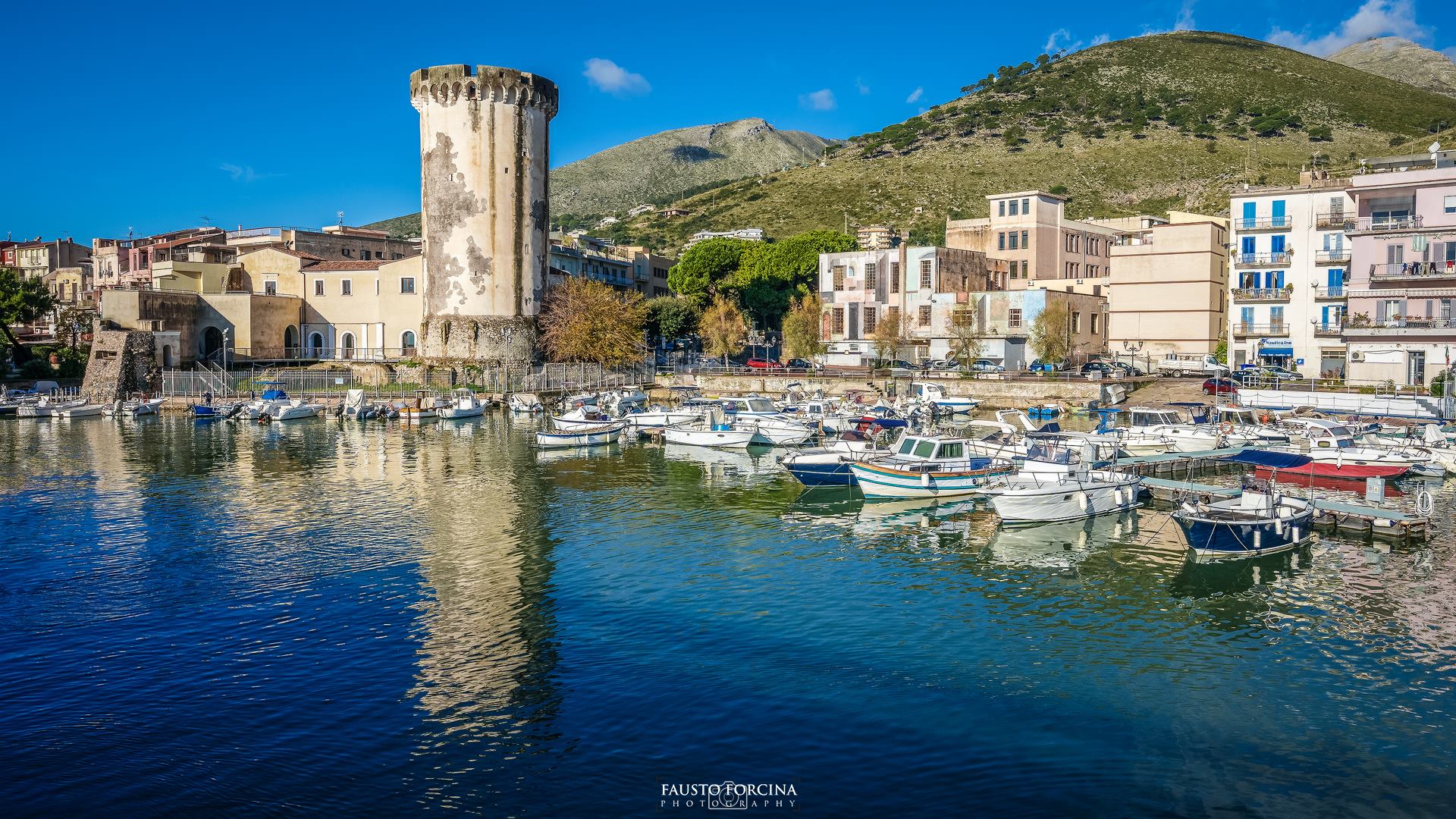
Town in the Aurunci Mountains. The ancients made up fantastical stories about it being the seat of Lestrigoni in the Odissey, of Antifata and Lamo. In this place occurred episodes of the journey made by Argounats and Aeneas, whose nurse buried inside the mountain as a tumulus which confines the gulf of Gaeta (in ancient times part of Formia) gave it its name.This theory, as Strabone’s pseudoscientific statement of a Spartan foundation hasn’t got any reason. Italian town , it was mentioned when it gained with Fondi the “civitas sine suffragio”, during the latin war in 338 B.C.. Then, In 188 B.C. it obtained the full roman citizenship and was ascribed to the Emilian tribe, as a proposal of the tribune of the plebs Gaio Valerio Tappone. It certainly became an Hadrian’s colony because it gained the name of Colonia Aelia Hadriana Augusta Formiae. During all the ancient times Caieta makes part of the Formian territory. Its position on the Appian way, in the spot where it is along the sea, the extraordinary amenity of the place and the mildness of the climate, made Formia and its gulf since the Republican times the roman’s favourite summer stay. There were built luxurious villas, that still nowadays are considered magnificent ruins. Aside from the tomb (almost untouched on the Caieta’s promontory) and the ruins of L.Munazio Planco’s villa, general of Caesar , you could find a round mausoleum so called l’Atratina, tomb of a certain Sempronio Atratino, and several ruins of villas from the territory of Gaeta to the borders of Minturno’s area; remarkable are those in the modern villa Rubino (already Caposele) considered as Cicero’s villa, memory of an amphitheatre. With the Roman decay, Formia degenerates too, just to become a small village almost completely destroyed towards the end of 9th century by the Saracen. An important clue of this decay is the transfer of the Roman Catholic Diocese from Formia to Gaeta, already happened in the 2nd half of the 8th century. After the defeat of Saracen at the Garigliano(915) river , the town came back to a new life, the tradition of the ancient name was lost, therefore the new village was called Mola, perhaps at the beginning of the 10th century, because of the mills raised along the several streams of that area. Thanks to the strategic position of the town in the 14th century Carlo II D’Angio ordered to built a famous Castle (tower of Mola) and similarly the Caetani built a Castle on the upper part of the city, that took the name of Castellone. In the 15th century the Aragonese ‘s domination granted in fiefdom the Tower of Mola to the Caetani, that kept it until 1805. In 1861 the ancient names replaced again the denominations of Torre di Mola and Castellone.
Bibl.: Corpus Inscr. Lat., X, p. 610; E. De Ruggiero, Diz. epigr., III, pagine 187-188; Weiss, in Pauly-Wissowa, Real-Encycl., VI, col. 2857 segg.; P. Gribaudi, I centri abitati del golfo di Gaeta, in Atti dell’XI Congresso geografico italiano, 1930. Per il mausoleo di Planco, v. G. Q. Giglioli, in Architettura e arti decorative, I (1922).
The predominant theory states that Formia would derive from the Greek “Hormiai” that means “calm and safe docking” as the historian and geographer Strabone affirms. Another hypothesis is that Formia could be a derivation of the latin word “Formus” which means warm and consequently a warm place. A third theory is a word I frequently come across ancient scripts concerning our territory. This term is “in Formis” often used to say in Formia. I’ve read that only the words with a greek origin can end with is or iis: Formis- Formiis. The toponym “in Formis” is actually connected with streams in its territory. These waterways are currently copious, even underground and flowing into the sea, and even more they have surely been in the past in our territory: from the Fons Artacia to the torrents Pontone and Rialto that in a rainier past could have been rivers with a good range having behind mountains and valleys from the Aurunci mountain chain . From the sources of S.Maria la Noce, which supplied the Cisternone, towards those in Mola such as the Mazzoccolo Source, from Rio Frigidus (nowadays Rio Fresco) to the S.Croce Torrent that collects the water of Capodacqua. From the source of Palombara to Castellonorato to the one of Acquaviva on the way for the Redentore. Looking at the toponym of many areas in Formia it’s strikingly evident the ancient presence of streams: Acqualonga, Acquatraversa, Ponteritto, Piscinola. In Formia there is also a street, Via della Forma, (where I have even lived in the 70s) near the Mazzoccolo source. The words “Forma” and “Formali”, in latin meant “water flow channels”. Some of the Cathedral or roman cities had been called “in“Formis” because of the presence of the sources. It’s important to underline that the latin word “Forma” also means “figure ordered in its parts” from which are originated the modern words: map, graphic paper, drawing, print. In medieval scripts we often find determinations as “ad formam” – “ad formas – ” in formis” – “Forma urbis”. Frontino speaks about “formae rivorum” referring to built channels and the violations of the farmers to pierce the aqueduct and canalise the water throughout “formae” or “formali” so called in the Middle ages. In conclusion, all of the above lets us suppose that the toponym of Formia, beside from “docking” and “hot”, as a third theory, can derive from the particular abundance in its territory of “formae” and “formali” of water flowing.
“It seems that the first member of the family to be nicknamed “Cicero” had been a respectable person; as a result, the descendants didn’t reject the nickname, rather preserved it with respect, without caring about who mocked them (and there were a lot)”.
In Latin, in fact, “cicer“ means chickpea; it seems like that ancestor had a fleshy growth on the tip of his nose, open in the middle exactly like a chickpea, from which the nickname would derive.
When our Cicero, the protagonist of this text, at the starting of his career, aspired to his first position, his friends had advised him to reject the nickname and to replace it with another one; however, he said, with his juvenile cockiness, that he would have demonstrated that the name Cicero could be more valuable than the “Scauri” or “Catuli”.
So, during his stay in Sicily, he devoted a silver object to the gods, on which he engraved his first two names, “Marco Tullio” ; instead of his third name, he jokingly ordered the artist to draw a chickpea. This is what has remained of his name.
This was entirely reported by Plutarch (45-102 bc) who came a century after Cicero’s death.
Cicero was certain that he would become more famous than Gens Scauro and Gens Catulo thanks to his culture and his abilities.
But who were the “Scauri” and the “Catuli” mentioned by Plutarch?
Like Cicero, whoever loved to stop over at Formia, knew about these two noble families, that boasted family members who had been part of the Consulate in the Republican period.
The “Scauro” Gens was a noble and rich family of soldiers, whose most famous member was Marco Emilio Scauro, buried in Pompei. The “Catulo” Gens was well known in Formia; in fact, Cicero, in one of his letters, talks about his neighbour in Formia “Sebosio, a friend of Catulo”.
Not by chance, in our Archaeological Museum we have preserved two funerary sheets bond together dedicated to Gaio Cesio Catulo and to a puppy dog, as the nickname “Catulo” actually means puppy. This is considered one of the rare funerary monuments with an “onomastic image”, according to the epigraphist Lidio Gasperini (in an article about Formiarum VI 1998 page 53).
Cicero‘s pride of coming from Formia then was also reinforced by the debates and friendships that he made because of his job. In fact, when he bought the villa in the year 70 b.C., he was aware of the possibilities of meeting relevant characters of the time, and among others, Pompeo Magno (106-48 b.C.) considered by the scholars one of the biggest owners of villas in the part of the city where Scipione the Aftrican also lived, according to Tito Livio and Gesualdo and to Lucio Afranio, consul in the year 60 b.C. along with Pompeo.
In Formia he met Lucius Munatius Plancus, whom he defended in a corruption trial, and Lucius Calpurnius Bestia, whom he defended six times when he was accused of electoral fraud.
The former was the adoptive father of Lucius Sempronius Atratino (the one of the Atratinian Mausoleum), who, politically tied to Caesar, with his friend Publius Clodius, denounced friend and former pupil of Cicero, Marco Caelio Rufo (who had a villa in Formia) who was brilliantly defended by Cicero with his oration “Pro-Caelio”.
The oration “Pro-Murena” was written by Cicero to defend one of his formian friends, accused of electoral fraud, and who will later become Mecenate’s brother-in-law, because of the marriage with her adoptive sister, Terenzia, also called Terentilla.
Cicero wrote to Atticus that his house in Formia had become a “court”, with a long line of clients and powerful Roman people that wanted to be received. “Basilicam habeo, non villam, frequentia Formianorum…”, as he wrote to his friend. Cicero knew that Formia was attended by the most powerful Romans, and that also Homer wrote about episodes that Ulysses lived in Formia. Virgilio, contemporary of Cicero, will halt there a stage of Enea’s journey. In 49 B.C., during the Civil War between Caesar and Pompeo, Cicero lived for a few months in Formia, where he was visited by Caesar.
Another important episode is Caesar “Dux”’s visit in the year 45 b.C. at Cicero’s home, as told by Erasmo Gesualdo.
When in 43 b.C. he learnt about his sentence to death while at Tuscolo’s villa, he decided to seek refuge in his villa in Formia, whence he would take a boat to leave for Greece and run away. However, unluckily, the wind coming from the east side (today known as “greek wind”), which lasted exactly for two to three days, made the departure more complex, already compromised by the square shaped latin sails of the time.
In a letter to Attic (19th of May of the year 49 b.C.), Cicero writes:
“Formia nunc sequimur, eadem nos fortasse furiae persequentur”
“Just now, I’m heading to Formia, perhaps the same avenging furies (he was writing about Caesar and his soldiers) will follow me there”.
In this occasion, as it will happen again in 43 B.C., Cicero perhaps desired to spend the last moments of his life in Formia.
The ancestors of Arpinio’s friends had seen this great Orator arise, but our ancestors saw him to live and to die in our land, that preserves not just one, but two tombs related to Cicero’s family.
The greatest scholars of M.Vitruvio Pollione and his work “De Architettura”: Ettore País, GQ Giglioli, Quirico Viviani, Vincenzo Tuzzi, the Marquis Poleni, the Barbaro, the architect Luigi Canina, Filandro, Balbo, Tiraboschi, Signorelli and especially Berardo Galiani, all state that M. Vitruvio Pollione belonged to the plebeian “gens Vitruvia” coming from Formia. Many data come from his only literary work written in old age and dedicated to Augustus. His greatest protector’s step-sisters was Octavia Major, daughter of Gaius Octavius and Ancaria, therefore step-sister of August and married to Sestus Appuleio.
In the preface to his work, Vitruvius states: “Together with M.Aurelio, P. Numidio and Cneo Cornelio I have already worked on the setting up of ballists, scorpions and other war machines and their maintenance…”
These three characters, Vitruvius’ s companions, were defined by Galiani, the greatest scholar of Vitruvius’ life , his fellow citizens, therefore Formiani, coming from Formiae.
An evidence of these names on potential local epigraphs and/ or on ancient writings, could already be decisive for the definitive certainty of his birth in our town.
Numidio, that is Publius Numisius is the architect who designed the Roman amphitheater in Herculaneum which is thought to have been very similar to the Roman theater in Formia.
Let us not forget that the largest number of epigraphs concerning the “Gens Vitruvia” was found in Formia and many are still visible in Villa Rubino.
From one of my recent readings of the vitruvian work, I was struck by some references to places very close to us and therefore well known by Vitruvius himself.
Vitruvius speaks about the Pontine Marshes, the water of the Neptune spring in Terracina (buried because poisonous) and about the “pozzolana” of Baia.
When he deals with the possible facilities of the harbour , he makes a description of a gulf that coincides exactly with our Sinus Formianus.
But the most interesting point is when in the second book he mentions the constructors Varrone and Murena, who are known to formian citizens both for local epigraphs and for narrations of Latin historians.
Varrone was “Curator Acquarum” (he had absolute control over the city’s water supply) in Formia and Murena was “Praetor” (roman magistrate) in Formia.
They were both contemporaries of Vitruvius and therefore his fellow citizens. Vitruvius also mentions Cicero, whom he certainly met in Formia.
It could almost be said that in his work Vitruvius also wanted to insert his birth certificate in Formia!!!!!!
It is also very interesting when he says that he lived together, with a certain C. Giulio, Massimissa’s son, often discussing Philology, first king of the Numidians. In fact, the historical facts are those as followed:
Massimissa’s grandson, Juba II, in the civil war between Caesar and Pompey, sided with the latter. He was defeated at Tapsus by Caesar and committed suicide. His son Juba I, still a boy, was brought by Caesar to Rome and grew up in Octavian’s, later Augustan’s family.
Vitruvius, surely knew this Juba II (Massimissa’s great-grandson) thanks to Augustus’ sister with whom he was very close to.
This young Numidian was given the name of C.Giulio and, at Augustus’ disposal, he was married to Cleopatra, Marcantonio’s daughter and of the egyptian Queen Cleopatra.
Giuba II, who took part in the battle of Azio with Ottaviano, was then allowed to return as king to Numidia, a roman province.
Numidia is the Tunisian region where Cartagine and Thibilis are located (previously called Announa of Numidia) where there is still an arch of Triumph, dated after Vitruvio’ s age, designed, built and subscribed by a certain MARCO VITRUVIO MAMURRA.
It was probably Vitruvio’s friendship with Giuba II which favoured a migration of his descendants to that roman province where there are some epigraphs with the name Vitruvius.
This discovery, as Giglioli says, made it realise that between Vitruvio and Mamurra must have been a kinship.
But they certainly weren’t the same person as some scholars claim.
They had different personalities. One was eccentric, outgoing and rich. The other, Vitruvio was humble, introverted and poor. The cities , beyond Formia, that are supposed to be the birthplaces of Vitruvio are: Fondi. – for the presence of a certain Vitruvio Vacco who in 327 BC led a revolt against Rome;
Fano. – f or a basilica that Vitruvio himself says he designed, but which has never been found and finally the city of Verona – For the Gavi’s arch designed by L. Vitruvio Cerdone which has nothing to do with M. Vitruvio Pollione.
In his work “De Architettura”, Vitruvio argues that’s any structure must be subject to the characteristics of solidity, usefulness and beauty. What thrilled artists like Brunelleschi, Palladio, Bramante, Raffaello and Antonio da Sangallo il Giovane.
In the third book, Vitruvio observes the human figure with its proportions (the Vitruvian Man) which fascinated Renaissance artists such as Leonardo da Vinci and León Battista Alberti.
Vitruvio designed several types of pipes, a clock, a hydraulic organ, and a sophisticated heating system for the thermal baths. He also invented an odometer for wagons based on the fall of a stone after a certain number of laps (practically the ancestor of our odometer).
His parents had him educated in science and new literature, but he “turned his soul to mathematics and civil and military architecture”.
In many texts it is reported as:
Vitruvio
L.Vitruvio
M.L. Vitruvio
Vitruvio
So, Marco, Lucio, Marco Lucio, Aulo. Sometimes it was written Vitruvius or Vetruvius.
Vitruvio himself, with extreme humility, writes:
“Dear emperor, I don’t possess by natural dowry a great stature, age has severely marked me and precarious health has taken away my strength, therefore, without these servants, I hope to obtain your benevolence by my scientific treatise “.
He was granted an annuity that took him out of a state of poverty.
This is the story of a great Citizen of Formia that many envy us.